Michael James Przybylek
Founder and Chief Project Manager
Broad Experience. Focused Skills.
Professional Experience
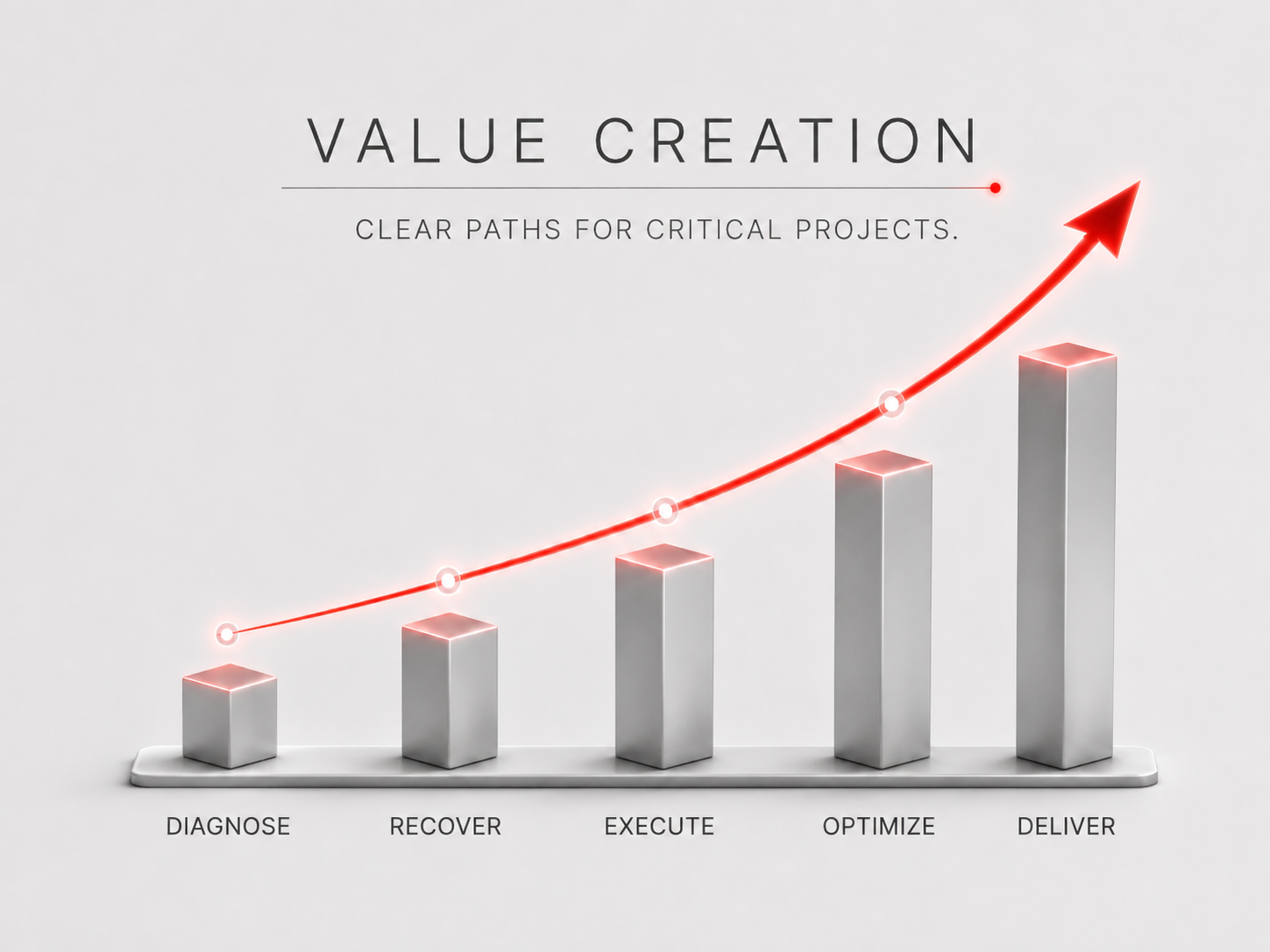
Michael James Przybylek brings more than 15 years of project leadership experience across the U.S.A. and Germany, with a strong focus on complex industrial programs where timing, technical uncertainty, suppliers, and cross-functional dependencies must be managed together across multiple time zones and cultures. In the automotive industry, he led approximately 20 customer and product-development projects representing more than €280 million in lifetime revenue, delivering roughly 95% on time and within budget.
At the Fraunhofer Research Institution for Battery Cell Production FFB in Münster, Michael designed and implemented a Quality Management System over 4 years, alongside winning a large grant and leading AI research in defect detection in battery production from the German government. His work included building the underlying quality management structure, defining quality gates and control mechanisms, and establishing the processes needed to support reliable industrialization, commissioning, and ramp-up. He delivered value by supporting by hands-on application of APQP, PPAP, FMEA, MSA, SPC, and Control Plan principles, in an unexposed environment.
Across these environments, Michael developed a hybrid project management style that satisfied traditional C-suite executives who wanted a clear detailed plan, as well as satisfying the project team needs for fast adaptability and clear, weekly priorities from the project manager. This style focused on the factors that determine whether critical projects succeed: a credible critical path, clear ownership, disciplined execution, early visibility of risks and dependencies, and decisive recovery when plans begin to slip.
Critical Project Management applies that experience to help organizations regain control of complex projects and move them toward delivery with clarity and confidence.
Industry Focus
Automotive suppliers, battery manufacturing, general advanced manufacturing, and complex technical programs. Cross-functional project environments where timing, coordination, and execution discipline directly determine delivery success.
Areas of Expertise
Critical path diagnostics, project recovery, interim project leadership, launch and ramp-up readiness, cross-functional alignment, governance cadence, risk and issue management, supplier coordination, and practical project-control systems that keep teams focused on what matters most.
Education
M.Sc. Materials Science and Engineering – FH Münster, Germany.
B.Sc. in Materials Science and Engineering – University of Michigan, Ann Arbor USA.
Certificates
Six Sigma Green Belt, Project Leadership Communication
Publications
A Capability Driven Quality Concept - Fraunhofer White Paper
Towards a Standardized Classification of Surface Defects in Electrode Manufacturing for Lithium Ion Batteries - Research Article in Batteries & Supercapacitors
Laser Focused on Critical Projects
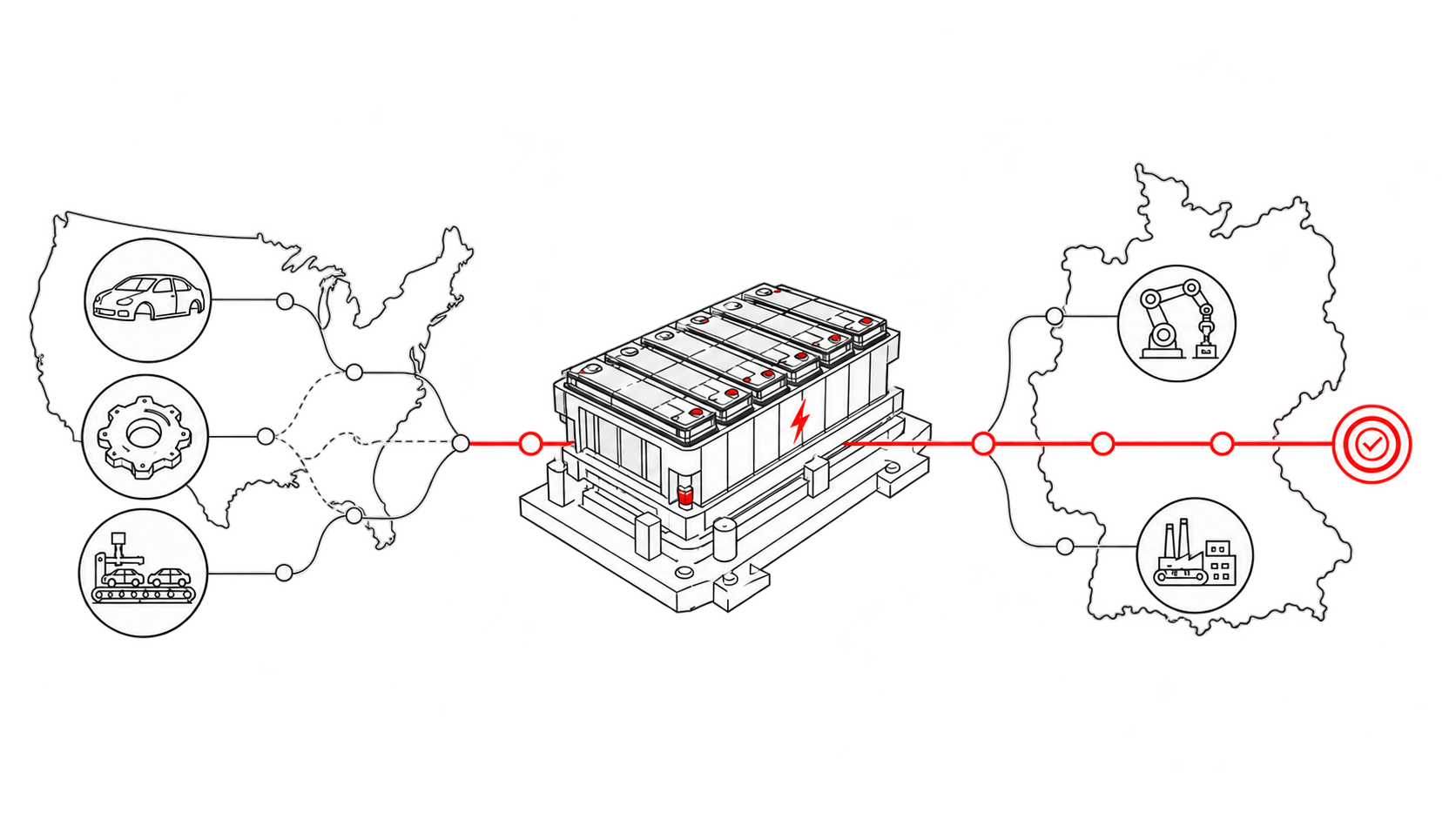
Our primary focus is supporting U.S. companies with operations, suppliers, customers, manufacturing facilities, engineering activities, or critical projects in Germany and Europe. Critical Project Management bridges American business priorities with European execution realities, helping international organizations improve project visibility, recover delayed programs, strengthen project controls, coordinate suppliers, manage industrialization and ramp-up, and deliver critical milestones with greater confidence.
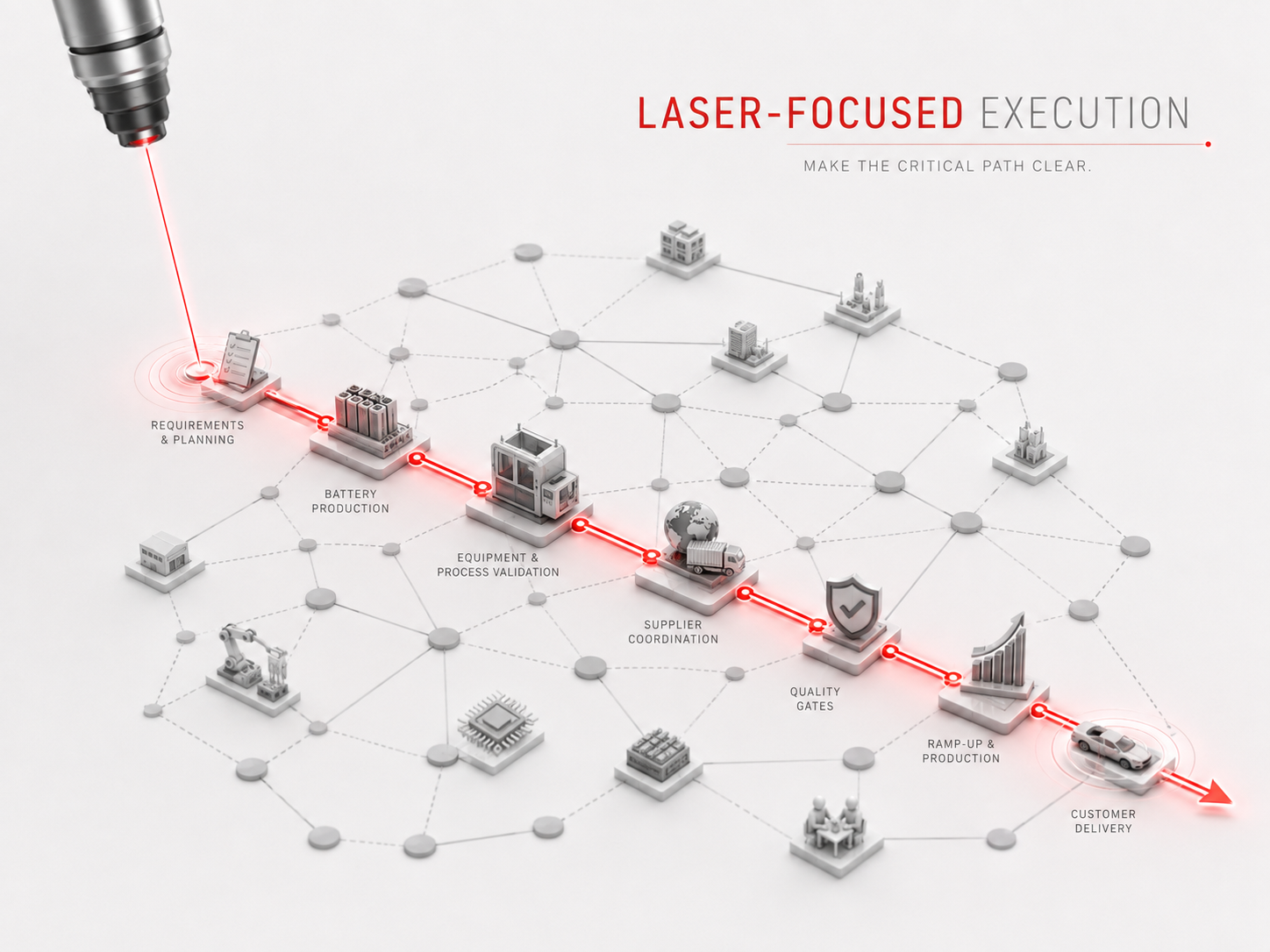
The goal is simple: make the critical path clear, align the organization around it, and create the execution discipline required to deliver.
Aligning Battery Industrialization Around the Critical Path
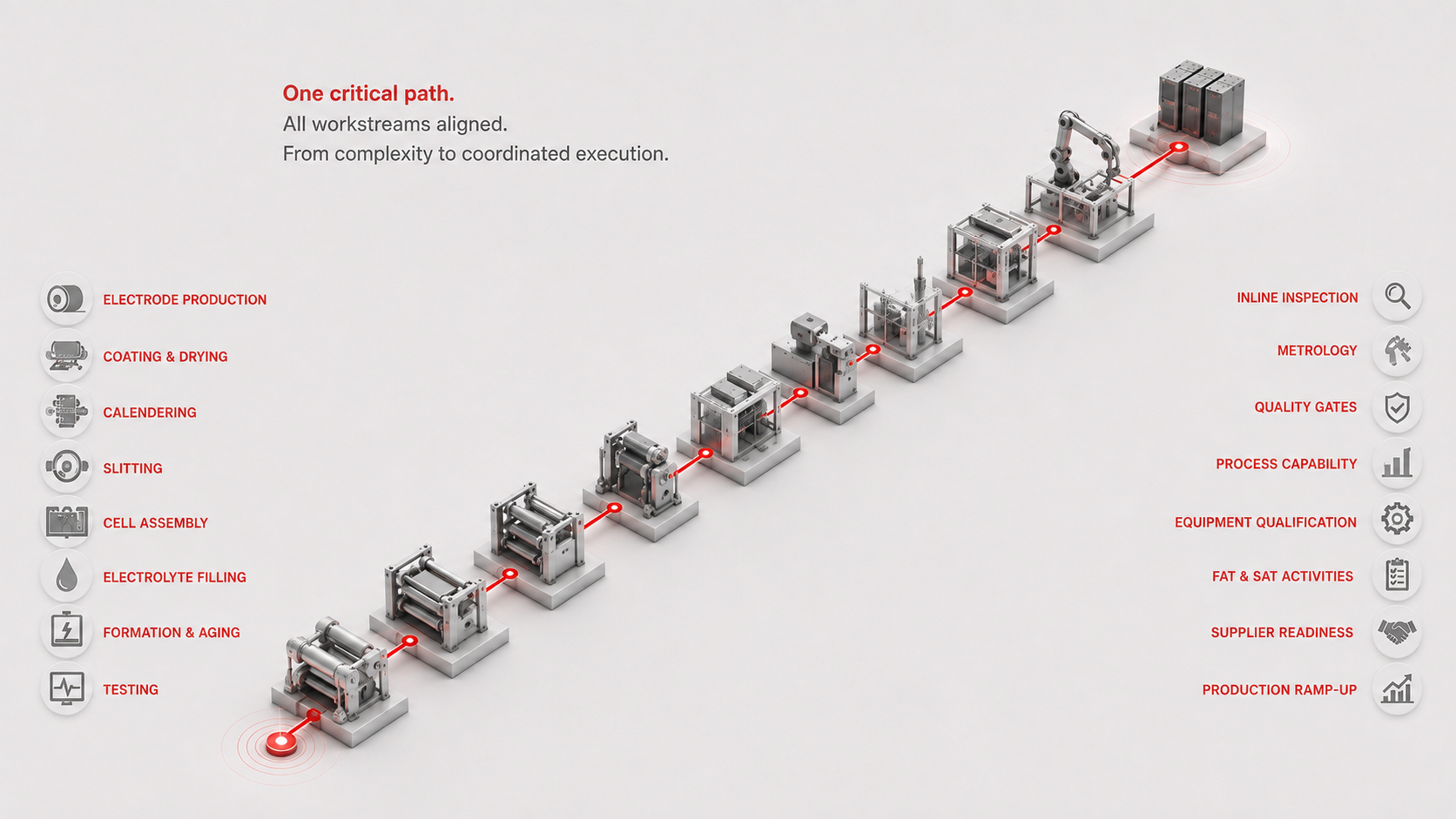
Battery manufacturing combines rapidly evolving technology with highly interdependent equipment, process, quality, and material requirements. Projects involve many advanced productions steps like electrode production, coating and drying, calendaring, slitting, cell assembly, electrolyte filling, formation, aging, and EOL testing, which are highly dependent on technology like in inline inspection, metrology, quality gates, process capability, equipment qualification, FAT and SAT activities, supplier readiness, and production ramp-up. When these activities are managed independently, technical uncertainty can quickly become schedule uncertainty. Critical Project Management brings these workstreams together around a common execution plan so that equipment readiness, product requirements, quality requirements, measurement capability, supplier commitments, and ramp-up milestones are aligned with the overall project timeline.
Delivering Complex Automotive Programs
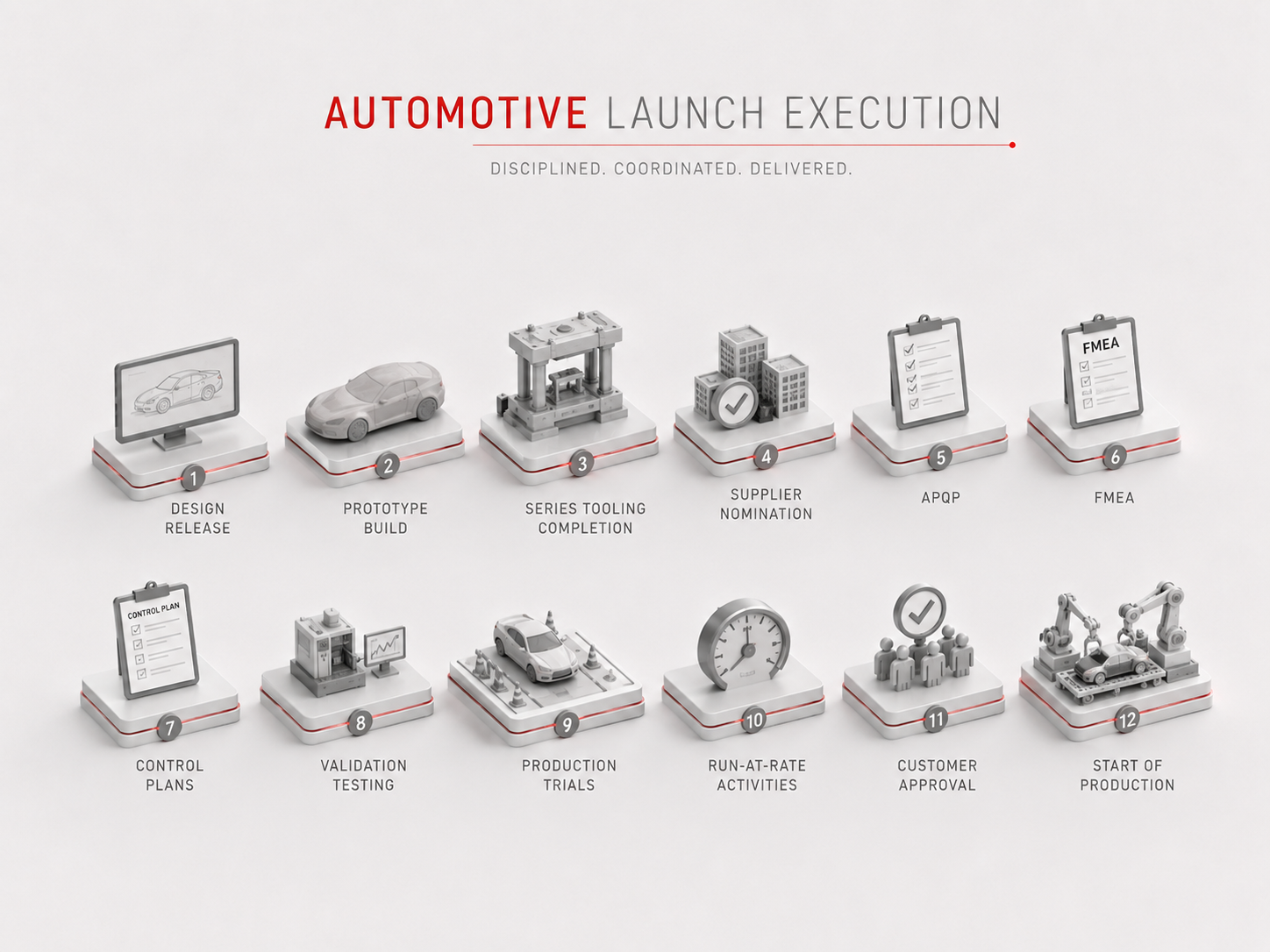
In the automotive industry, successful project delivery depends on disciplined coordination across product development, manufacturing engineering, quality, procurement, suppliers, tooling, validation, logistics, and customer requirements. Automotive programs are driven by hard launch dates and interconnected milestones between design releases, prototype builds, tooling completion, supplier nominations, APQP, PPAP, FMEA, control plans, validation testing, production trials, run-at-rate activities, customer approvals, and SOP. Delays in one area can quickly propagate through the entire launch plan. Critical Project Management helps automotive suppliers and manufacturers establish a credible time plan and identify the real critical path, find schedule risks early, coordinate internal and external dependencies, and keep project teams focused on the milestones that directly affect customer delivery.
Managing Semiconductor Sequences
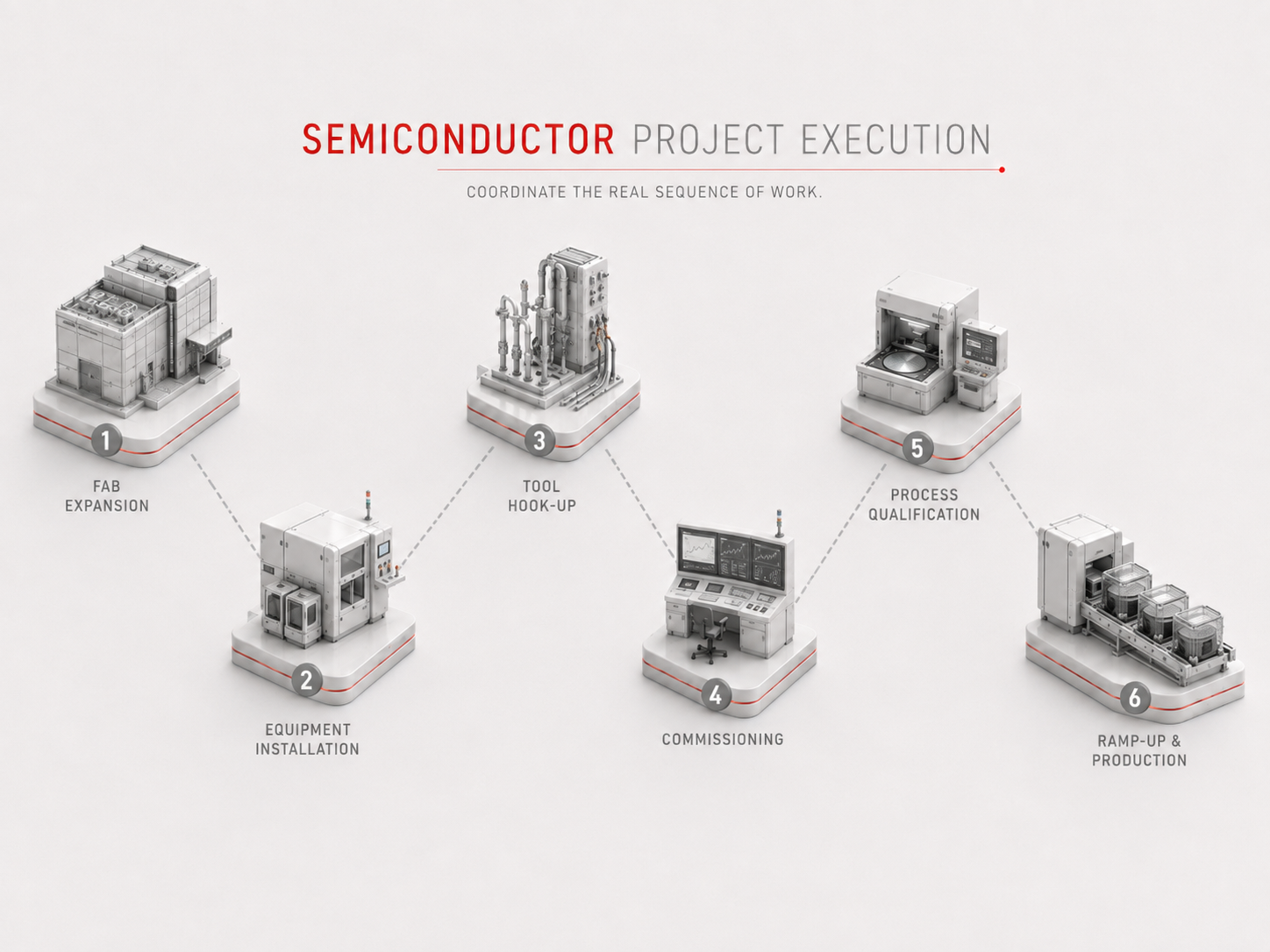
The same principles are highly relevant in the semiconductor and electronics industries, where major projects often involve complex equipment, long supplier lead times, complex interfaces, automation, process qualification, cleanrooms, highly specialized technical teams, and demanding ramp-up targets. Because many of these activities are technically dependent on one another, project teams need more than a high-level milestone plan, they need a project manager that can find and manage the critical path.
More Than Project Administration
Across battery manufacturing, automotive, semiconductors, advanced manufacturing, and complex industrial projects, Critical Project Management is designed for situations where organizations need more than project administration. We focus on turning complexity into a clear execution system: a credible schedule, visible dependencies, defined ownership, disciplined follow-up, proactive risk management, and management information that supports timely decisions.
FROM COMPLEXITY TO EXECUTION